Resume With an Employment Gap: What to Say (2026)

How to handle an employment gap on your resume: whether to explain it, wording that works, the format that helps, and a complete example.

Template:

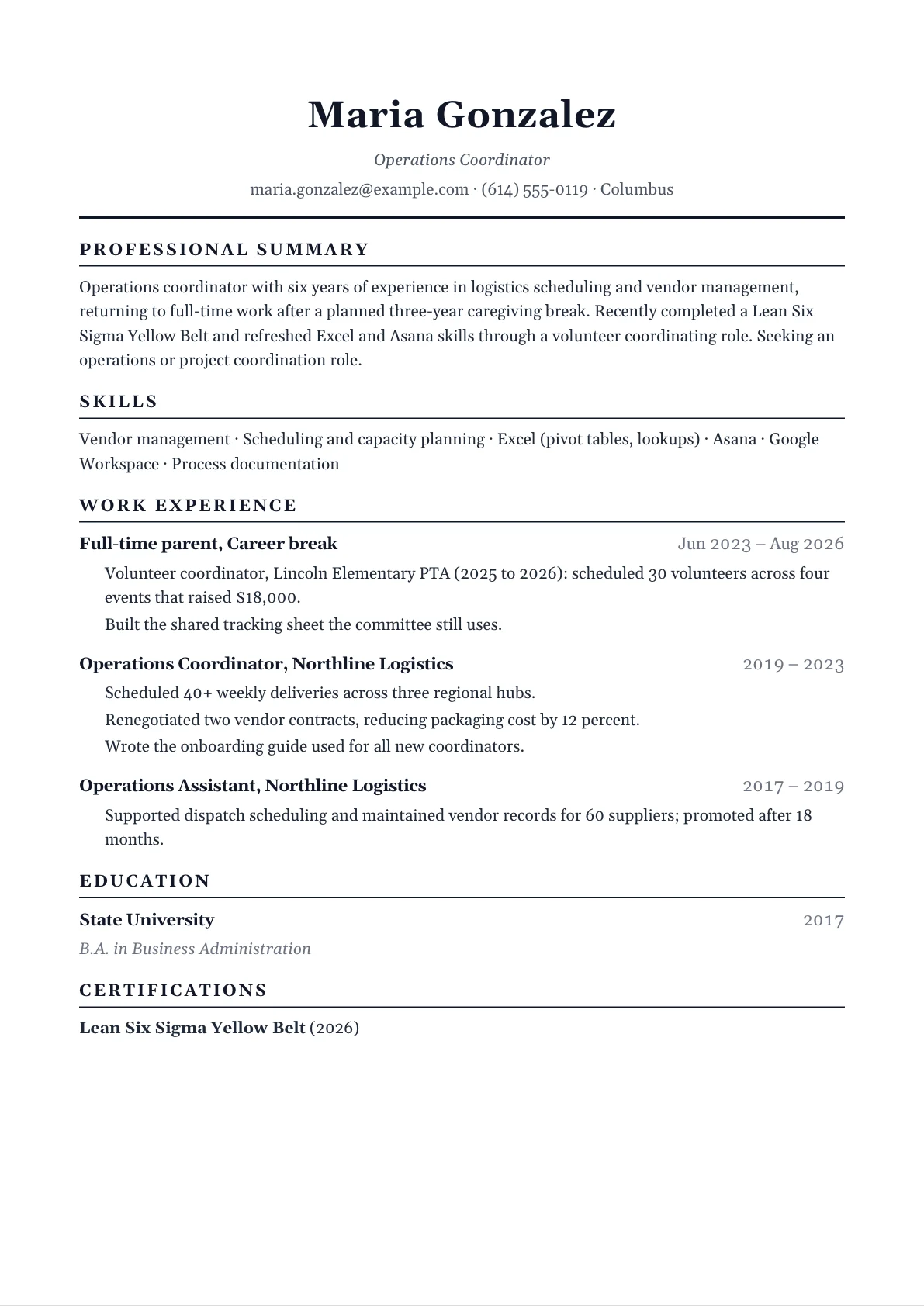
An operations coordinator returning to full-time work after a three-year caregiving break.

Why this resume works

  • The break is its own dated entry, so the timeline has no silent hole for a recruiter to wonder about.
  • Skills sit above the work history, so current ability is visible before the dates.
  • A 2026 certificate and a volunteer role with a number in it show the skills never went stale.
Edit & download this resume

Edit it in the free builder, then download the PDF with no watermark. A free account is only needed to download.

An employment gap is not the problem it used to be. Time away for caregiving, illness, education, layoffs, travel or simply a needed pause is common enough that most recruiters have one on their own resume. What still costs people interviews is not the gap itself. It is a resume that either tries to hide the gap, which recruiters notice immediately, or over-explains it, which turns a normal life event into the whole story.

This guide shows how to present an employment gap so it takes up the space it deserves and no more: how to decide whether to explain it, the exact wording that works, which resume format helps, a complete example for someone returning after three years, and answers to the questions people actually ask. If the gap coincides with a move into a different field, pair this with the career change resume guide.

How to write a resume with an employment gap

1

Decide how visible the gap really is

List your roles with month and year. A gap under six months usually needs no comment at all; recruiters expect job searches to take time. A gap of a year or more will be noticed, so plan to address it once, briefly, rather than hoping it goes unseen.

2

Lead with a summary that speaks to now

Three sentences at the top: who you are professionally, the strengths you are bringing back, and what you want next. Write it in the present tense. If it feels right, one clause can name the break plainly: Returning to full-time project management after a three-year caregiving break. Said once, up front, it stops being a question.

3

Give the break its own entry if you did something during it

If you studied, freelanced, volunteered, ran a household, cared for someone or built anything, list it in the experience section with dates like any other role. A title such as Career break: full-time caregiver or Independent study: data analytics certificate with one or two bullets is honest, keeps the timeline continuous, and gives the reader something to ask about other than the gap.

4

Put skills above history if the history is old

When your most recent role ended several years ago, a short skills section directly under the summary lets you show what you can do before the reader reaches the dates. Keep it concrete: tools, methods, certifications, languages. This is the combination format, and it is the one most career-returners should use.

5

Refresh anything that has aged

Tools change. If you were in marketing three years ago, the platforms have moved on; if you were in accounting, the software has. A recent certificate, a short course or even a listed self-study project signals that you have closed the gap yourself, which is the main thing an employer is unsure about.

6

Keep the explanation out of the resume, mostly

The resume names the break. The cover letter, if there is one, gives it two sentences. The interview is where you say a little more if asked. Do not put a paragraph of explanation on the resume itself; it draws attention to exactly the thing you want to move past.

How to word an employment gap on a resume

The wording matters less than people fear, as long as it is plain and brief. These lines all work as an experience entry, with a date range next to them:

  • Career break: full-time parent (2023 to 2026)
  • Career break: family caregiver (Mar 2024 to Aug 2026)
  • Planned sabbatical: travel and language study (2025)
  • Medical leave (2024 to 2025). No further detail is required, and employers may not ask for it.
  • Professional development: Google Data Analytics Certificate, SQL, Tableau (Jan to Jun 2026)
  • Freelance bookkeeping (2024 to 2026), with two bullets on clients and results.

Under the entry, add one or two bullets only if you have something concrete: a certificate earned, volunteer responsibility with a number attached, a freelance project delivered. If the break was simply a break, the title and dates are enough. Do not invent activity to fill it.

Two things to avoid: euphemisms that sound like a cover-up (consultant with no clients, independent projects with nothing to show) and apologetic language. You are not asking permission. You are reporting a timeline.

Which resume format is best for an employment gap?

Three formats exist and only one is a good fit for most returners.

  • Reverse-chronological. The standard. Use it if the gap is short (under a year) or if your last role ended recently. It hides nothing, which is fine, because short gaps do not need hiding.
  • Combination (skills first, then chronological history). The best choice for a break of a year or more. A skills block under the summary shows what you can do before the dates appear, and the full history still follows, so nothing looks concealed.
  • Functional (skills only, no dated history). Avoid it. Recruiters recognize the functional format as the one people use to hide something, and many applicant tracking systems cannot parse it. It creates the suspicion it was meant to prevent.

Whichever you choose, use years only in the date column if it helps (2021 to 2023 rather than exact months) as long as you are consistent throughout. Using months for some roles and years for others is the kind of inconsistency recruiters are trained to spot.

The example, line by line

An operations coordinator returning to full-time work after three years as a full-time parent. The example uses the combination format: summary, skills, then history with the break listed as an entry.

Summary: Operations coordinator with six years of experience in logistics scheduling and vendor management, returning to full-time work after a planned three-year caregiving break. Recently completed a Lean Six Sigma Yellow Belt and refreshed Excel and Asana skills through a volunteer role coordinating a 30-person school fundraising committee. Seeking an operations or project coordination role.

Skills: Vendor management, scheduling and capacity planning, Excel (pivot tables, lookups), Asana, Google Workspace, process documentation, Lean Six Sigma Yellow Belt (2026).

Experience:

  • Career break: full-time parent (Jun 2023 to Aug 2026). Volunteer coordinator, Lincoln Elementary PTA (2025 to 2026): scheduled and managed 30 volunteers across four events that raised $18,000; built the shared tracking sheet the committee still uses.
  • Operations Coordinator, Northline Logistics (2019 to 2023). Scheduled 40+ weekly deliveries across three regional hubs; renegotiated two vendor contracts, reducing packaging cost by 12 percent; wrote the onboarding guide used for all new coordinators.
  • Operations Assistant, Northline Logistics (2017 to 2019). Supported dispatch scheduling and maintained vendor records for 60 suppliers; promoted to coordinator after 18 months.

Education and certifications: B.A. Business Administration, State University, 2017. Lean Six Sigma Yellow Belt, 2026.

The gap is visible, named, dated and given a bullet with a number in it. The reader learns in the first three lines that this person is back, current and capable, and the break becomes one entry among several instead of the subject of the resume.

Mistakes to avoid

  • Deleting dates to hide the gap. A resume with no dates reads as a resume with something to hide, and most applicant tracking systems require them.
  • Stretching a previous role's end date. Background checks and reference calls surface this, and it turns an ordinary gap into a dishonesty problem.
  • Over-explaining. One line names the break. Paragraphs of context make it the headline.
  • Leading with the oldest, most senior title. Lead with the summary and current skills. Your history comes next, and it still counts.
  • Sending an old resume with a new date range added. Rewrite the summary, update the skills, and check that every tool listed is one you could use tomorrow.

A career break often comes with a second situation. These guides cover the ones that overlap most:

Every situation is in the resume examples hub. Pricing questions are answered on the FAQ; the short version is that the PDF download is free, with no watermark, on every plan.

Update it free, no watermark

Import your old resume from PDF or Word, rewrite the summary, add the break as an entry, and download a clean PDF. Free, no watermark, no credit card, and the builder works without an account.

Frequently asked questions

Should I explain an employment gap on my resume?

Name it, briefly, if it is a year or longer: one experience entry with a plain title such as Career break: family caregiver and the dates. Gaps under six months usually need no comment. Save any further explanation for the cover letter or interview.

How do I explain a gap in employment for caregiving or being a stay-at-home parent?

List it as an entry in your experience section: Career break: full-time parent, with dates. Add one bullet only if you have something concrete from that time, such as a volunteer role with a number attached or a course completed. Keep it factual and brief.

What is the best resume format for an employment gap?

The combination format: a summary, then a short skills section, then your full reverse-chronological history with the gap listed as an entry. It shows current ability before the dates appear without hiding anything. Avoid the functional format; recruiters associate it with concealment.

Can I leave dates off my resume to hide a gap?

You can, but it backfires. A resume without dates signals that something is being hidden, and many applicant tracking systems require dates to parse your history. Use years only if you prefer, applied consistently to every role.

How long does an employment gap have to be before it matters?

Under six months is rarely noticed; a normal job search takes that long. Six months to a year may prompt a question in an interview. A year or more should be named on the resume so the reader is not left guessing.

Do employers still care about resume gaps?

Less than they did. Career breaks are common enough that many recruiters have taken one themselves, and major job platforms now let people list a career break as a position. What employers care about is whether your skills are current and whether you are ready to return, so address those directly.

Should I include freelance or volunteer work done during the gap?

Yes, as regular experience entries with dates and results. Freelance and volunteer work during a break is the strongest evidence that your skills stayed active, and it keeps the timeline continuous.

What if I was laid off and have been searching for a while?

List the role with its true end date. If the search has run past a year, a one-line entry such as Career transition: job search and professional development, with any courses or certificates listed, keeps the timeline honest. Do not stretch the previous end date.

How do I show my skills are still current after a long break?

Add a recent certificate, course or self-directed project to the education or skills section with its date, and make sure every tool in your skills list is one you could use today. A single 2026 credential does more than a paragraph of reassurance.

Can I build a resume with an employment gap for free?

Yes. CVPoet lets you import your old resume from PDF or Word, restructure it in a single-column ATS-safe template, and download the PDF free with no watermark. No account is needed to start.

Rewrite your resume for the return

Import the old one, fix the summary, name the break and download a clean PDF. Free, no watermark, no card.

Build your resume, free
Resume example with an employment gap
Resume example with an employment gap The example above as an image, to save or share. To change it, use Edit & download this resume at the top of the page. Open the full-size image