Entry-Level Resume: Examples and Tips (2026)

How to write an entry-level resume for your first full-time job after school or job training: what counts as experience, a full example and a free template.

Template:

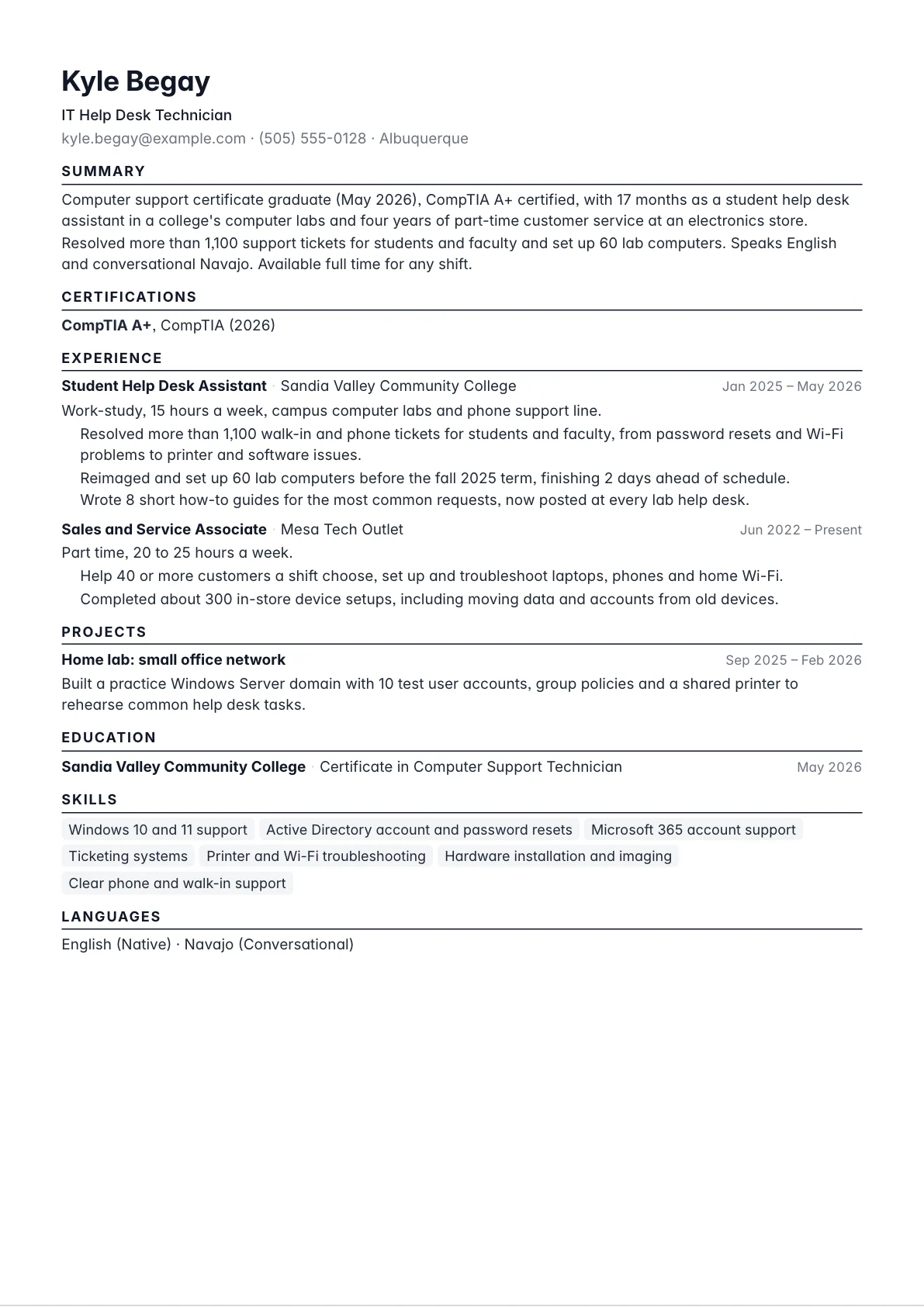
A computer support certificate graduate with part-time retail and campus help desk experience applying for a full-time IT help desk technician job at a regional health system.

Why this resume works

  • CompTIA A+ sits right under the summary, because many help desk postings ask for it by name and the reader can check it off at once.
  • The campus work-study job is written as real help desk experience (1,100 tickets, 60 computers set up 2 days early), because it is the same work the new job pays for.
  • The part-time electronics store job stays, with 40 or more customers a shift, since explaining technology to people who are frustrated is half of help desk work.
Edit & download this resume

Edit it in the free builder, then download the PDF with no watermark. A free account is only needed to download.

An entry-level resume is for the move from part-time work, school or a training program into your first full-time job in a field. Maybe you just finished a certificate, a trade program, a bootcamp or the classroom part of an apprenticeship. Maybe you finished high school a few years ago and have been working part time since. Either way, you have something a first-time job seeker does not: training that taught you the work, and a record of showing up to real jobs. The resume's task is to connect those two things to the job in front of you.

This guide is for that step. If you are a teenager looking for your first paid job, the first job resume guide fits better, and if you just finished a bachelor's degree, use the recent graduate resume guide. Below: how to read an entry-level posting, where your credential goes, how to turn part-time and school jobs into proof you can handle full time, and a complete example for a computer support certificate graduate applying for a help desk job.

How to write an entry-level resume

1

Sort the posting into must-haves and nice-to-haves

Entry-level postings often list more than they need. Required items (a certificate, a license, a driver's license, the ability to lift 50 pounds, weekend shifts) are the ones to meet. Preferred items, including 1 to 2 years of experience preferred, are a wish list. If you meet most of the required items, apply, and count your training and part-time work toward the experience line.

2

Write a headline and summary for the job, not your situation

Use the posting's job title as your headline: IT Help Desk Technician, not Recent certificate graduate seeking opportunities. In the summary, name what you finished and when, the credential, how long you have done related work (in months or years, even part time), one or two results, and that you are available full time.

3

Put the credential where it is seen first

If the job asks for a certificate or license, list it right under the summary with the issuing body and the year. CompTIA A+, for example, takes two exams, Core 1 and Core 2, and is aimed at help desk and support jobs. For trade and health programs, add the hours of hands-on training, clinical, lab or shop work the program included.

4

Show that part-time work already proves full-time habits

Two or four years of part-time work shows you arrive on time, learn systems, handle customers and stay. List those jobs with dates and weekly hours, and write each bullet around something a full-time employer needs: the number of customers or orders you handle, the responsibility you were trusted with, a result you improved.

5

Add projects, labs or externships as experience

What you built or practiced in training counts: a home lab, a shop project, a capstone, an externship, a ride-along, a practicum. Give it a name, dates and one line with a number (10 test accounts, 40 clinical hours, a finished cabinet built to a drawing). It shows you can do the work, not just that you studied it.

6

Keep it to one page and tailor it for each application

One page is right at this stage. For each job, change the headline to match the title, move the most relevant experience up, and use the posting's words for skills you really have. Keep a list of everything, and cut from it for each version.

How an entry-level resume differs from a first-job or graduate resume

These three resumes are easy to mix up. The difference is what you have to show and what the employer is hiring for.

  • First job resume: for teens and others with little or no paid history, applying for part-time or starter jobs. It leans on school, activities and availability.
  • Entry-level resume: for the first full-time job in a field, after a certificate, trade program, bootcamp, apprenticeship or a few years of part-time work. It leans on the credential, the training and a real work record.
  • Recent graduate resume: for the first job after a bachelor's or higher degree, where internships, projects and the degree carry the page.

A strong entry-level order is: headline and summary, the certificate or license the job asks for, experience (related work first, including work-study and externships), projects or practical training, education, then skills and languages. If you have no related work yet, move training and projects above experience. Once you have a certificate or degree beyond high school, you can drop your high school from the page.

Keep the layout to one column so hiring systems read it cleanly. The Compact design in the example fits a certificate, two jobs and a project on one page; you can switch between all four CVPoet templates without retyping.

The example, line by line

The example is for Kyle, who finished a computer support certificate in May 2026 and is applying for a full-time help desk job at a health system.

Headline: IT Help Desk Technician, the exact title in the posting.

Summary: the certificate and its date, CompTIA A+, 17 months of help desk work and four years of customer service, two results (more than 1,100 tickets, 60 computers), a second language, and full-time availability for any shift. A health system runs support around the clock, so that last line matters.

Certification: CompTIA A+ with the issuer and 2026, first after the summary.

Student Help Desk Assistant: labeled work-study with 15 hours a week, and written as a real support job: 1,100 tickets, 60 computers set up 2 days early, 8 how-to guides still in use.

Sales and Service Associate: part time since 2022 at 20 to 25 hours a week. Two bullets (40 or more customers a shift, about 300 device setups) show patience and hands-on skill with ordinary users.

Project: a home lab with 10 test accounts that shows he practices the exact tasks, like password resets and group policies, that a new technician handles in week one.

Education, skills and languages: the certificate program, seven skills in the posting's words, and English and Navajo.

Mistakes that hold entry-level resumes back

  • Training reduced to one line. Certificate, Computer Support hides months of hands-on work. Add the credential, the practical training and a project with a number.
  • Dropping part-time jobs as irrelevant. A retail or restaurant job held for years is evidence of reliability, the thing an entry-level employer worries about most. Keep it with two strong lines.
  • Not applying because of an experience line. If the posting says preferred, it is not a requirement. Meet the required items and let the resume show your training and work.
  • Listing every tool you touched once. A skills list with Linux, Python, Cisco and cloud tools you saw in one class invites questions you cannot answer. List what you can do on day one.
  • No start date or availability. Full-time employers often need someone for a set shift. Say you are available full time, and for which shifts.

These guides cover the situations on either side of this one:

Every example is in the resume examples hub, grouped by job and situation.

Build it free, no watermark

CVPoet's resume builder is free to use without an account. Start from this example or a blank page, pick one of four ATS-friendly designs, and download a PDF with no watermark on any plan.

Frequently asked questions

What is an entry-level resume?

A resume for your first full-time job in a field, usually after a certificate, trade program, bootcamp, apprenticeship or a period of part-time work. It leads with your training and credential, then your work record.

What if an entry-level job asks for 1 to 2 years of experience?

If the experience is listed as preferred, apply when you meet the required items. If it is required, count related part-time work, work-study, externships and clinical or shop hours, and say how long each lasted.

Should my certificate go at the top of my resume?

Yes, if the job asks for it. Put it right after the summary, with the issuing body and year, so the reader can confirm it without searching.

Should I include part-time jobs on an entry-level resume?

Yes. Keep them with dates and weekly hours and one or two lines each. They show you can hold a job, which matters as much as skills for a first full-time role.

Do I need a summary on an entry-level resume?

Yes, three short sentences: what you finished and when, your credential and related experience, and that you are ready to work full time. Skip objective statements about what you hope to gain.

Should I list my high school?

Only if it is your highest level of education or the job asks for a diploma. Once you have a certificate or degree beyond high school, you can leave it off.

How long should an entry-level resume be?

One page. If yours runs over, cut older or unrelated part-time jobs down to one line and shorten the skills list.

How do I list training hours or clinical hours?

Under the program in your education section or as its own entry, for example Externship, 160 hours, with the site and two or three things you did there.

Can a class project go on my resume?

Yes, if it matches the work. Give it a name, dates and one line with a number that shows what you built or did.

What is the difference between entry-level and first job resumes?

A first job resume is for someone with little or no paid work, often a teenager. An entry-level resume is for someone with training and some work history moving into full-time work in a field.

Build your entry-level resume

Start from Kyle's one-page example or a blank page. No account needed, and the PDF is free with no watermark.

Build your resume, free
Entry-level resume example
Entry-level resume example The example above as an image, to save or share. To change it, use Edit & download this resume at the top of the page. Open the full-size image