Server Resume: Examples and Tips (2026)

Server resume example for waiters and waitresses: skills, bullets, alcohol and food handler training to list, official pay figures and a free template.

Template:

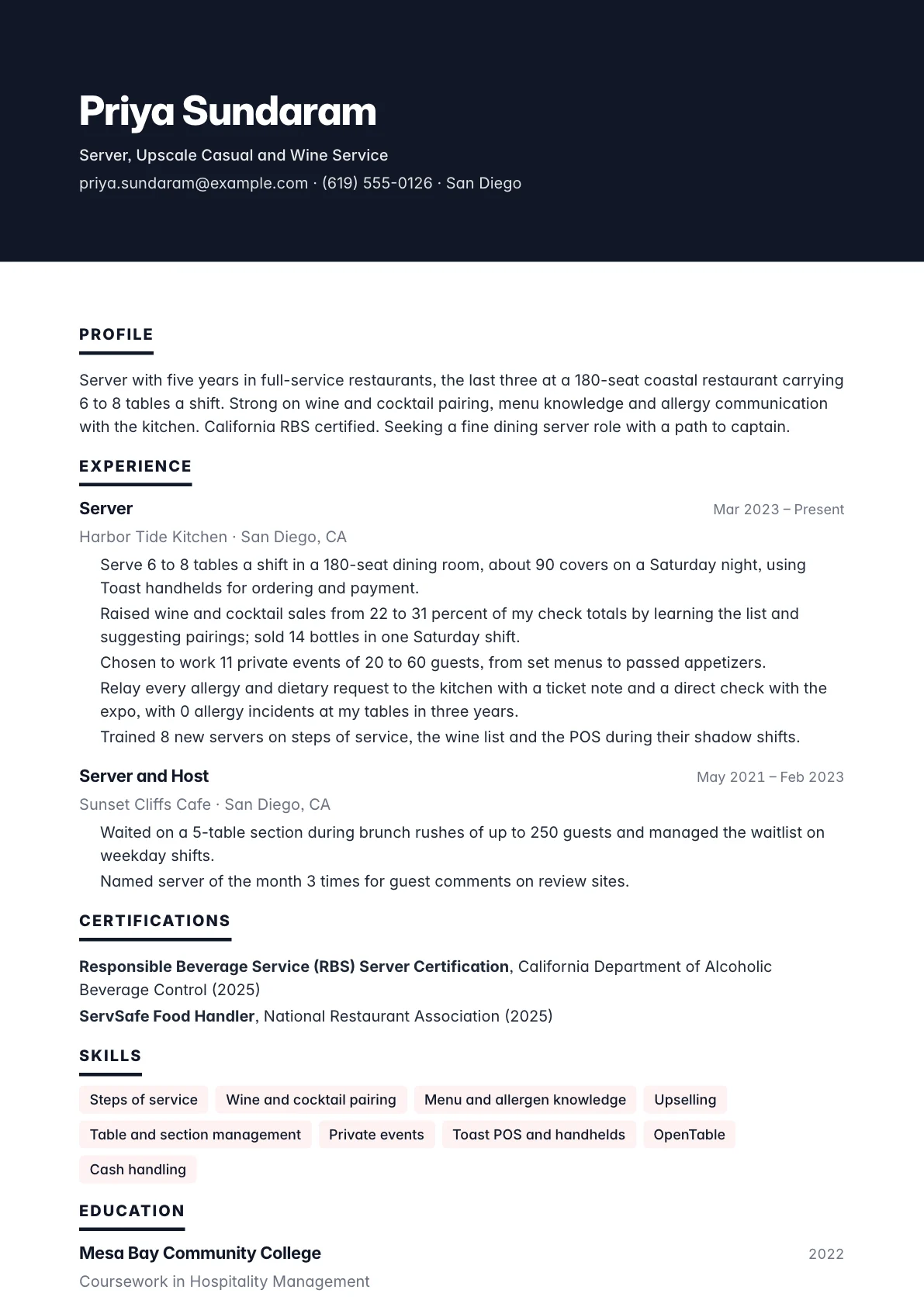
A server with five years in upscale casual dining applying for a server position at a fine dining restaurant with a wine program.

Why this resume works

  • The size of her section and the pace are specific: 6 to 8 tables and about 90 covers on a Saturday, which tells a fine dining manager she can handle volume before slowing down to tasting menu service.
  • Sales are shown the way managers track them, a wine and cocktail share that rose from 22 to 31 percent of her checks and 14 bottles in a single night.
  • Her California alcohol server certification and food handler card are listed with the issuer and year, the credentials a California manager asks about before a first shift.
Edit & download this resume

Edit it in the free builder, then download the PDF with no watermark. A free account is only needed to download.

Restaurants hire servers for three reasons: they keep guests happy, they sell, and they make the shift run smoothly for everyone else. A general manager skimming your resume wants to know what kind of room you have worked (a 40-table diner, a hotel steakhouse, a tasting menu), how many tables you carry, and whether you know the menu, the wine list and the point of sale system well enough to work a Friday without hand-holding.

This guide shows what to put on a server resume, how to turn a busy section and good sales into numbers, which alcohol and food safety training to list and where, sample summaries and bullets, and a complete example for a casual dining server moving up to fine dining. If you have never waited tables, pair this with the no experience resume guide.

Server pay and job outlook

Official figures for Waiters and Waitresses.

Median pay (2025)
$35,230 per year ($16.94 per hour)
Jobs in 2025
2,284,400
Job outlook, 2025 to 2035
2%, slower than average
Change in jobs, 2025 to 2035
+46,500
Typical entry-level education
No formal educational credential
On-the-job training
Short-term on-the-job training

BLS and O*NET list servers under their official title, waiters and waitresses.

Sources: U.S. Bureau of Labor Statistics, Occupational Outlook Handbook: Waiters and Waitresses, checked September 2026; O*NET OnLine: Waiters and Waitresses, checked September 2026.

How to write a server resume

1

Say what kind of service you do

Your headline is the type of room and service: Server, Fine Dining, Banquet Server, Server and Bartender, Cocktail Server. A manager hiring for a steakhouse wants to see the words they would use in their own job post.

2

Open with your section and your strengths

In two or three sentences give your years, the kind of restaurant, how many tables you carry and what you are good at (wine, craft cocktails, large parties, speed at breakfast). End with the job you want. A short, specific summary beats a paragraph about loving people.

3

Turn your shifts into numbers

Tables per section, covers per shift, the size of the dining room, party sizes you handle, events you worked. If your restaurant tracks sales, use it: check average, wine or dessert share, bottles sold. Keep them honest and round down if you are not sure.

4

Show the parts of service managers worry about

Allergy handling, cash and card accuracy, working with the kitchen, and handling a complaint so the guest comes back. One bullet on each is worth more than a list of adjectives.

5

List your alcohol and food safety training

If you serve alcohol, list your server training with the name of the program, the issuer and the year. Add a food handler card if you have one. Where these are required by state or local law, managers screen for them first.

6

Add tools, languages and a short education line

Name the POS and reservation systems you use (Toast, Square, Aloha, OpenTable, Resy). A second language is a real advantage in many dining rooms. Education can be one line; for most server jobs, experience matters more.

Skills and keywords for a server resume

These are the skills restaurant server postings mention most. Use the ones that are true for you, worded the way the posting words them.

Hard skills

  • Steps of service and table maintenance
  • Menu, ingredient and allergen knowledge
  • Wine, beer and cocktail recommendations
  • Suggestive selling and upselling
  • Order entry and splitting checks
  • Cash handling and closing out
  • Checking ID for alcohol service
  • Large party and private event service
  • Tableside service and wine presentation
  • Opening and closing side work

Soft skills

  • Reading a table and adjusting the pace
  • Staying friendly during a rush
  • Handling complaints calmly
  • Clear communication with the kitchen and bar
  • Teamwork on a shared floor
  • Remembering regulars and their orders

Tools and software

  • POS systems: Toast, Square, Aloha or Micros
  • Handheld ordering tablets
  • Reservation systems: OpenTable, Resy or SevenRooms
  • Card readers and mobile payments
  • Scheduling apps such as HotSchedules or 7shifts
  • Wine keys, decanters and bar tools

Server resume summary examples

Choose the one closest to where you are, then change the restaurant type, numbers and goal to match your own.

First serving job

Host and busser with one year at a busy family restaurant, seating up to 200 guests on weekend nights and helping servers run food and reset tables. Know the menu and the POS from covering phones and to-go orders. Food handler card current; looking for my first server position.

Experienced server

Server with four years in a high-volume sports bar and grill, carrying 7 tables and large parties on game nights. Quick, accurate order entry on Aloha and a steady record of closing out without cash errors. Seeking a server role in a full-service restaurant with a bar program.

Fine dining server or captain

Fine dining server with eight years in tasting-menu and a la carte rooms, currently a captain leading a team of three for a 12-table section. Completed an advanced restaurant wine course and strong in tableside service and pacing multi-course meals. Seeking a captain or head server role.

Server resume bullet examples

Each bullet names what you did, adds a number and shows why it mattered to the restaurant or the guest.

  • Served a 7-table section in a 220-seat restaurant, averaging 70 covers on weekend nights.
  • Grew dessert and after-dinner drink orders to 1 in 3 tables by describing the menu before the check.
  • Handled parties of up to 24 guests on a single check without kitchen delays.
  • Closed out $2,500 or more in sales on busy shifts with no cash drawer errors in two years.
  • Worked 40 banquets and weddings of 100 to 300 guests, serving plated and family-style dinners.
  • Checked ID for every guest ordering alcohol under the restaurant's card-all policy, with zero violations in 3 compliance checks.
  • Earned a 4.9 average guest rating on the reservation app's server feedback over 12 months.
  • Trained 6 new hires on table numbers, steps of service and allergen procedures.
  • Turned 5-course tasting menus for up to 4 tables at once while keeping each course on the kitchen's timing.
  • Resolved guest complaints at the table and turned 9 of 10 into return visits, tracked through the reservation system.
  • Worked breakfast, lunch and dinner shifts, covering 15 extra shifts during the summer season.

Alcohol and food safety training for servers

You do not need a license to be a server, but many states, counties and cities require alcohol server training, a food handler card, or both, and the rules vary by place. The agency that sets them is usually your state alcohol control board and your state or local health department. California is one example: its Department of Alcoholic Beverage Control requires on-premises alcohol servers to complete Responsible Beverage Service training and pass the state exam within 60 days of starting the job, and the certification is valid for three years (as of September 2026). Other states require no training at all, while some employers or insurers require it anyway. The programs servers list most often:

  • ServSafe Alcohol from the National Restaurant Association: responsible alcohol service training, with state-specific material added where a state asks for it.
  • TIPS (Training for Intervention ProcedureS) from TIPS: on-premise, off-premise and other alcohol service courses, customized by state.
  • State alcohol server certification where your state runs its own program, such as California's RBS certification. List the exact name and the agency.
  • Food handler card such as ServSafe Food Handler, where your state or city requires it for staff who handle food.

The example, line by line

The example is for Priya, a server in San Diego with five years in upscale casual restaurants who wants a fine dining job. Here is what each part is doing.

Headline: Server, Upscale Casual and Wine Service. It gives her level of service now and the skill that bridges to fine dining.

Summary: five years and a 180-seat room first, then 6 to 8 tables a shift, her strengths (wine, menu knowledge, allergies), her RBS certification, and the goal, with a captain role as the next step so the manager sees she plans to stay.

Experience: five bullets at Harbor Tide Kitchen. Volume first (about 90 covers on a Saturday, Toast handhelds), then sales in the terms a manager tracks (22 to 31 percent wine and cocktail share, 14 bottles in one shift), then trust (11 private events of 20 to 60 guests), then safety (0 allergy incidents), then leadership (8 new servers trained). Her cafe job has two lines: a 5-table brunch section for up to 250 guests and server of the month 3 times.

Certifications: her California RBS certification from the Department of Alcoholic Beverage Control and her ServSafe Food Handler card, both from 2025.

Skills, education and languages: nine skills that mix service, sales and systems, her hospitality coursework, and conversational Tamil.

Mistakes that cost servers interviews

  • Listing duties every server has. Took orders and served food is the job description. Say how many tables, what kind of room and what you sold.
  • Leaving out alcohol training. If you are certified, list the program and the year. In places that require it, a manager may not be able to put you on the floor without it.
  • Writing about tips. Your tip income is not a result a manager can check. Sales, covers, guest ratings and repeat guests say the same thing in their terms.
  • No POS or reservation system named. A manager who uses Toast or Aloha wants to know you can start without long training. Name the system.
  • A gap-filled list of short jobs. Restaurant jobs are often short. Keep the most relevant four or five, and group seasonal work under one heading if needed.

Other hospitality and customer-facing resume examples:

Every example is in the resume examples hub, grouped by job and situation.

Build it free, no watermark

CVPoet's resume builder is free to use without an account. Start from this example or a blank page, pick one of four ATS-friendly designs, and download a PDF with no watermark on any plan.

Frequently asked questions

What should I put on a server resume?

A headline naming the kind of service you do, a short summary, each restaurant with the size of the room and your section, bullets with covers, sales and guest results, your alcohol and food handler training, the POS and reservation systems you use, and any second language.

How do I write a server resume with no experience?

Lead with any guest-facing work: host, busser, barista, fast food, retail or volunteer events. Show that you are quick, friendly and reliable, and get a food handler card and alcohol server training if your area requires them. Aim your summary at a first server job.

Do I need alcohol server certification to be a server?

It depends on your state and sometimes your city or county. Some states require on-premises servers to complete training within a set time, and others do not. Many employers require it anyway. Check your state alcohol control agency and ask the restaurant.

What is the difference between TIPS and ServSafe Alcohol?

Both are responsible alcohol service programs that teach checking ID, spotting signs of intoxication and refusing service. ServSafe Alcohol is run by the National Restaurant Association and TIPS is its own program. Which one you need depends on what your state and employer accept.

What skills should a server list on a resume?

Steps of service, menu and allergen knowledge, wine and cocktail recommendations, upselling, order entry and closing out, checking ID, and handling large parties. Add the POS and reservation systems by name.

Should I include my sales numbers?

Yes, if your restaurant tracks them and you know them. Check average, wine or dessert share, and bottles sold are all numbers managers use. Do not guess or include private figures you were asked not to share.

How long should a server resume be?

One page. Keep the four or five most relevant jobs and one or two lines for older ones.

Should I list bartending on a server resume?

Yes. Bar experience helps you sell drinks and cover the service bar. Use a headline like Server and Bartender if you want to be considered for both.

How do I move from casual dining to fine dining on my resume?

Highlight wine knowledge, pacing multi-course meals, private events and any tasting menu or high check average experience. A course or certification in wine can help, and your headline should name the service style you want.

Should I put my food handler card on my resume?

Yes, with the name of the card, the issuer and the year. It saves the manager a question and shows you are ready to start.

Build your server resume now

Start from Priya's example or a blank page. Free, no account needed, and the PDF has no watermark.

Build your resume, free
Server resume example
Server resume example The example above as an image, to save or share. To change it, use Edit & download this resume at the top of the page. Open the full-size image