Caregiver Resume: Examples and Tips (2026)

Caregiver resume example for home care and personal care jobs: summaries, bullets, skills, home health aide training rules, and a free template.

Template:

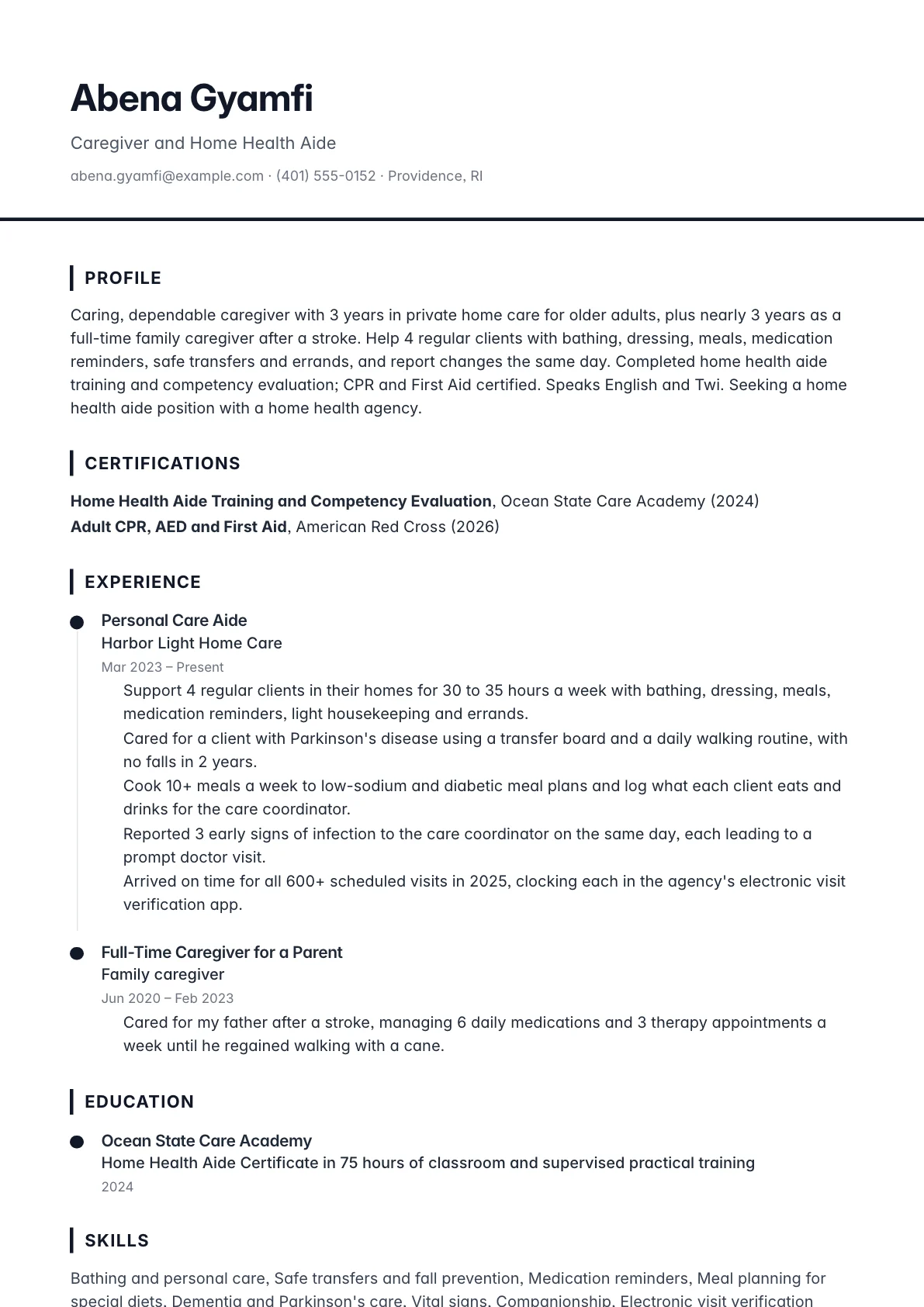
A personal care aide with three years in private home care, plus earlier years caring for a family member, applying for a home health aide job at a Medicare-certified home health agency.

Why this resume works

  • Her home health aide training and competency evaluation is listed first, because a Medicare-certified agency has to confirm it before she can make visits.
  • Reliability and safety are shown with numbers: 600+ visits in 2025 all on time, and a client with Parkinson's disease with no falls in 2 years.
  • Nearly three years caring for her father after a stroke is listed as a real job, with 6 daily medications and 3 therapy visits a week, instead of being left as a gap.
Edit & download this resume

Edit it in the free builder, then download the PDF with no watermark. A free account is only needed to download.

Families and home care agencies hiring a caregiver are trusting you with someone they love, alone, in their home. That is what your resume has to speak to. The person reading it wants to know who you have cared for and what their needs were, what help you gave each day, whether you show up on time every time, and whether you notice when something is wrong and tell the right person. Training and certifications matter too, especially for agencies that bill Medicare.

This page has a full example for a personal care aide moving to a home health agency, six steps for your own resume, summaries for new, experienced and senior caregivers, bullet examples, the skills agencies ask for, and the federal training rules for home health aides, with a link to the official text. Caring for a family member counts as experience; the example shows how to list it. If you want to work in a nursing home or hospital, see the CNA resume example.

Caregiver pay and job outlook

Official figures for Home Health and Personal Care Aides.

Median pay (2025)
$35,800 per year ($17.21 per hour)
Jobs in 2025
4,677,100
Job outlook, 2025 to 2035
18%, much faster than average
Change in jobs, 2025 to 2035
+847,300
Typical entry-level education
High school diploma or equivalent
On-the-job training
Short-term on-the-job training

The Bureau of Labor Statistics reports caregivers as home health and personal care aides, so these figures cover both kinds of aide.

Sources: U.S. Bureau of Labor Statistics, Occupational Outlook Handbook: Home Health and Personal Care Aides, checked September 2026; O*NET OnLine: Personal Care Aides, checked September 2026.

How to write a caregiver resume

1

Use a headline with the kind of care you give

Write Caregiver, Personal Care Aide or Home Health Aide, whichever matches the posting and your training, and add a focus if you have one: older adults, dementia care, adults with disabilities, hospice. Agencies sort applicants by these words.

2

List training and certifications near the top

Home health aide training, CNA certification, CPR and first aid, dementia care training: each with the school or organization and the year. For agencies that take Medicare, the home health aide training and competency evaluation is often the first thing they check.

3

Write a warm, factual summary

How long you have been a caregiver and for whom, the daily help you give, the conditions you have experience with, your training, languages, and the job you want. Keep it plain and specific. Families respond to facts more than to big words about compassion.

4

Describe clients and results, never names

Say what help you gave and to whom, in general terms: a client with Parkinson's disease, 4 older adults. Add numbers such as hours a week, visits, meals and clients, and results such as no falls, fewer hospital visits or on-time records. Never use a client's name or private health details beyond what the job needs.

5

Count family caregiving as experience

If you cared for a parent, spouse or child, list it like a job with the dates and what you did. It explains the time away from paid work and shows real skills: medications, appointments, safe transfers and patience.

6

Finish with education, skills and languages

Add your training program and any schooling, the care skills the posting uses, and every language you speak with clients. One page is right for almost every caregiver resume.

Skills and keywords for a caregiver resume

These are the skills home care and personal care postings mention most. Use the ones that are true for you, in the posting's words, and back a few of them up in your bullets.

Hard skills

  • Bathing, grooming, dressing and toileting
  • Safe transfers, walking help and fall prevention
  • Medication reminders
  • Meal planning and cooking for special diets
  • Vital signs, where the agency allows
  • Light housekeeping and laundry
  • Dementia and memory care
  • Skin checks and repositioning
  • Errands, shopping and transportation to appointments
  • Recording care notes and changes in condition

Soft skills

  • Patience and kindness
  • Reliability and punctuality
  • Respect for privacy and independence
  • Noticing and reporting changes
  • Calm in emergencies
  • Clear communication with families and nurses

Tools and software

  • Electronic visit verification (EVV) apps
  • Agency scheduling and care note apps
  • Gait belts, transfer boards and walkers
  • Hoyer lifts and shower chairs
  • Blood pressure cuffs and thermometers
  • Pill organizers and medication reminder systems

Caregiver resume summary examples

Pick the summary that sounds most like you and change the details. Each one says who you care for, what you do and what you are looking for.

New caregiver

Kind and dependable new caregiver who completed a 75-hour home health aide program and spent 2 years helping care for my grandmother with dementia. Comfortable with bathing, meals, walking help and keeping a daily care log. CPR and First Aid certified, with a driver's license and my own car. Seeking a part-time or full-time caregiver position with a home care agency.

Experienced caregiver

Home health aide with 6 years in home care, supporting older adults with dementia, heart failure and diabetes. Visit 5 to 6 clients a day across the city, following each care plan and reporting changes to the supervising nurse. Known for a perfect attendance record in 2025 and strong family feedback. Seeking a full-time home health aide role with regular clients.

Senior or live-in caregiver

Live-in caregiver with 12 years of private and agency experience, including 5 years with one client through advanced Alzheimer's disease and hospice. Manage daily routines, medications on schedule, therapy visits and family updates, and train relief caregivers on each client's needs. CNA and dementia care trained. Seeking a live-in or senior caregiver position.

Caregiver resume bullet examples

These bullets show the same caring work in a way an agency can measure. Change the details to your own clients, without names.

  • Visit 5 to 6 home health clients a day across a 15-mile area, following each nurse's care plan.
  • Provide live-in care 5 days a week for an older adult with Alzheimer's disease, keeping a calm daily routine that reduced evening agitation.
  • Help 3 clients with showers and dressing each morning using shower chairs and grab bars, with no falls in 18 months.
  • Prepare 3 meals a day for a client on a renal diet, tracking fluids to stay within the doctor's daily limit.
  • Drive clients to 8 to 10 medical appointments a month and share visit notes with families the same evening.
  • Kept a client with limited movement free of pressure sores for 14 months by repositioning every 2 hours and checking skin daily.
  • Worked 40+ hours a week of respite care for 2 families, giving family caregivers time off.
  • Trained 5 new caregivers on safe transfers and each client's routines during shadow shifts.
  • Earned the agency's caregiver of the quarter award twice after positive feedback from 4 client families.
  • Record care notes after every visit in the agency app, with 100 percent of notes complete by shift end.
  • Provided comfort care and companionship to 6 hospice clients in their final weeks, working with the hospice nurse.

Training and certifications for caregivers

Training rules depend on where you work. Home health aides employed by agencies that take part in Medicare fall under a federal rule: an aide must complete a training and competency evaluation program, a competency evaluation alone, or a state-approved nurse aide program with good standing on the state registry. Training must total at least 75 hours, with at least 16 hours of classroom training before at least 16 hours of supervised practical training. Aides then need at least 12 hours of in-service training every 12 months, and an aide who goes 24 consecutive months without paid aide work must complete a new program. Personal care aides and private caregivers are covered by state rules that differ widely, and many agencies train their own staff. List what you hold:

  • Home health aide training and competency evaluation, with the school or agency and the year. Say how many hours if your program ran longer than 75.
  • Certified Nursing Assistant (CNA), if you have it, with the state registry. It also qualifies you for many home health jobs.
  • CPR and First Aid from the American Red Cross or the American Heart Association.
  • Dementia care, hospice or special diet training from an agency or community college, with the year.
  • State credential for personal care or home health aides, where your state requires one, with the state named.

The example, line by line

This is Abena's resume. She has three years as a personal care aide for a home care company and wants a home health aide job with an agency that bills Medicare.

Headline: Caregiver and Home Health Aide. Both titles are there, so she matches private care and agency searches.

Summary: 3 years in private home care and nearly 3 years of family caregiving first. Then 4 regular clients and the daily help she gives, her training and CPR, her languages, and the home health aide job she wants.

Certifications: her home health aide training and competency evaluation from 2024, and CPR, AED and First Aid.

Experience: the first bullet sizes the job, 4 clients and 30 to 35 hours a week. The second is a safety result, no falls in 2 years for a client with Parkinson's disease. Then 10+ meals a week on special diets, 3 changes she reported the same day, and 600+ visits in 2025, all on time. Her family caregiving from 2020 to 2023 is listed like a job with 6 daily medications and 3 therapy appointments a week, which explains the years and proves the skills.

Education, skills and languages: her certificate program with 75 hours of training, eight care skills, and English and Twi, which matter for matching her with clients.

Caregiver resume mistakes to avoid

  • Using a client's name or private details. Describe clients by their needs only, such as an older adult with dementia. Privacy is part of the job, and your resume shows you know that.
  • Leaving family caregiving off. Years caring for a relative are experience. Without them, the time looks like a gap.
  • Only adjectives. Compassionate and caring is on every caregiver resume. Numbers like hours, clients and on-time visits prove it.
  • No training listed. Agencies that bill Medicare have to check home health aide training. Put yours near the top with the year.
  • Forgetting practical details. A driver's license, a car, languages and the hours you can work are often deciding factors in home care. Include the ones that apply.

Other healthcare resume examples that are close to this one:

Every example is in the resume examples hub, grouped by job and situation.

Build it free, no watermark

CVPoet's resume builder is free to use without an account. Start from this example or a blank page, pick one of four ATS-friendly designs, and download a PDF with no watermark on any plan.

Frequently asked questions

What should I put on a caregiver resume?

A headline, a short summary, your training and certifications, each caregiving job with clients, hours and results, family caregiving if you have done it, your training program, care skills and languages.

How do I write a caregiver resume with no experience?

List any care you have given to family, neighbors or through volunteering, like a job with dates and tasks. Add your training, CPR and first aid, and jobs that show reliability, such as food service or childcare.

Can I put caring for a family member on my resume?

Yes. List it as <em>Family Caregiver</em> with the dates and what you did, such as managing medications, appointments and daily care. Keep private health details short.

What is the difference between a caregiver, a personal care aide and a home health aide?

The words overlap. Personal care aides and private caregivers usually help with daily living, meals and companionship. Home health aides often work for agencies under a nurse's care plan, and those at Medicare-certified agencies must meet federal training rules.

How many hours of training does a home health aide need?

For agencies that take part in Medicare, federal rules require at least 75 hours, including at least 16 hours of supervised practical training, or a passed competency evaluation. States can add their own rules.

What skills should a caregiver list?

Personal care, safe transfers, fall prevention, medication reminders, meal preparation, dementia care, reporting changes, and the apps you use. Add patience and reliability through your bullets.

Should I list my driver's license on a caregiver resume?

Yes, if the job involves driving clients or visiting several homes. Say you have a valid license and a reliable car.

How do I describe clients without breaking their privacy?

Use general terms such as <em>an older adult with Parkinson's disease</em> or <em>4 regular clients</em>. Leave out names, addresses and personal details.

How long should a caregiver resume be?

One page. Put your training and most recent caregiving job at the top.

Do I need to be a CNA to work as a caregiver?

Not always. Many personal care jobs train you on the job, and home health aide programs are another route. A CNA certification opens more doors, including nursing homes and hospitals.

Build your caregiver resume now

Start from Abena's example or a blank page. It is free and needs no account, and the PDF has no watermark.

Build your resume, free
Caregiver resume example
Caregiver resume example The example above as an image, to save or share. To change it, use Edit & download this resume at the top of the page. Open the full-size image