Registered Nurse Resume: Examples (2026)

Registered nurse resume example with summaries, bullet points, skills and the licenses to list, plus official pay and job outlook figures and a free template.

Template:

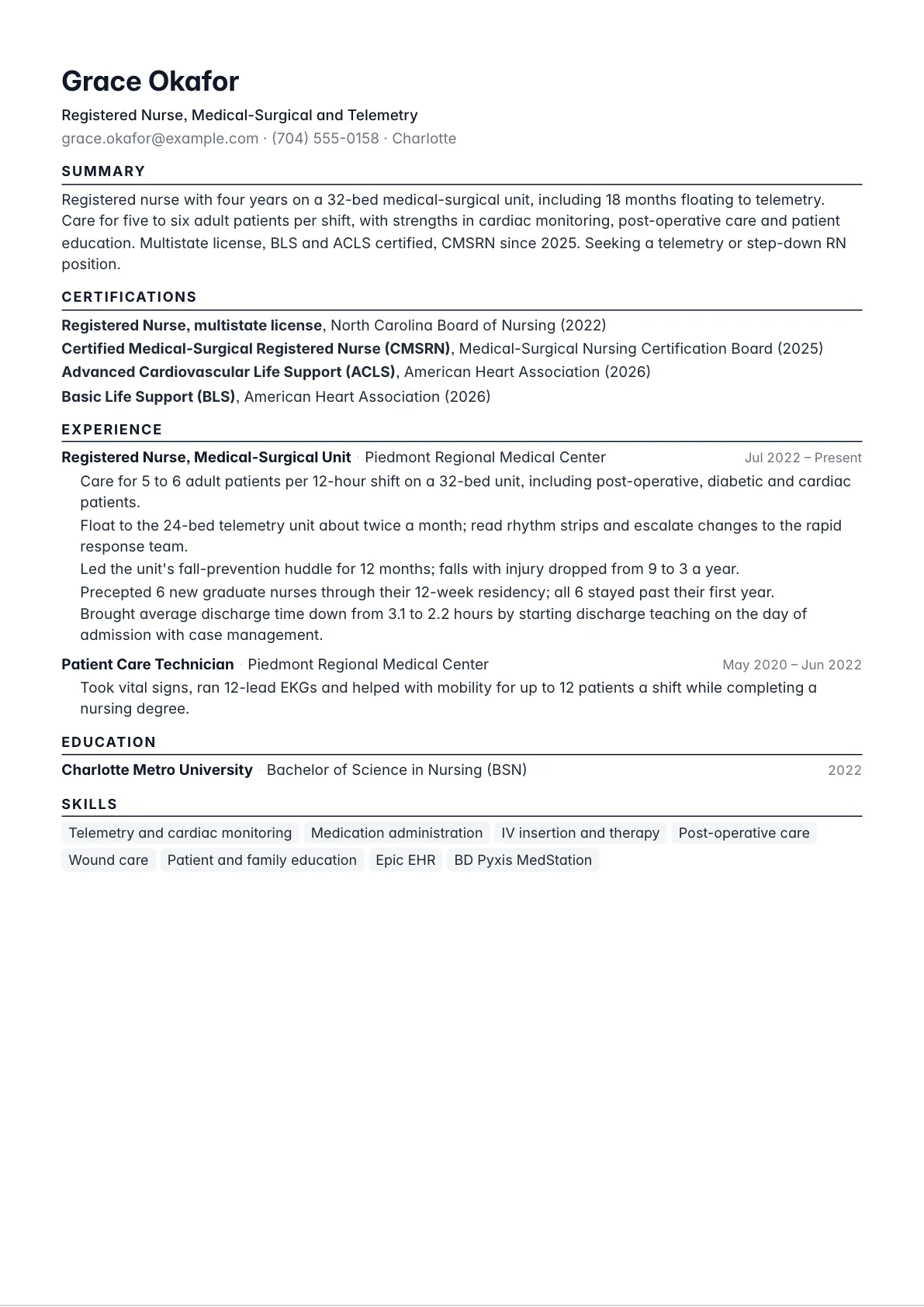
A medical-surgical RN with four years of experience applying for a telemetry nursing position.

Why this resume works

  • Licenses and certifications come first, so the screening questions (licensed where, BLS, ACLS) are answered before the reader reaches the work history.
  • Each bullet gives the unit, the patient load and a result: 5 to 6 patients a shift, falls with injury down from 9 to 3, six new graduates precepted.
  • The telemetry float experience is spelled out, because it is the bridge between the job she has and the job she wants.
Edit & download this resume

Edit it in the free builder, then download the PDF with no watermark. A free account is only needed to download.

A registered nurse resume is read by two audiences in a row. First a recruiter or the hiring system checks the basics: an active license in the right state, Basic Life Support, the specialty certifications the unit needs, and the kind of unit you have worked on. Then a nurse manager reads it to picture you on their floor: how many patients you take, what kind, and whether you make the unit better. A strong RN resume answers both, in that order.

This guide covers what goes on a registered nurse resume, where the license and certifications belong, summary and bullet examples you can adapt for new graduate, experienced and senior nurses, the skills hiring managers search for, and a full example for a medical-surgical nurse moving into telemetry. Moving into advanced practice? The nurse practitioner resume example covers what changes.

Registered nurse pay and job outlook

Official figures for Registered Nurses.

Median pay (2025)
$97,550 per year ($46.90 per hour)
Jobs in 2025
3,465,400
Job outlook, 2025 to 2035
6%, faster than average
Change in jobs, 2025 to 2035
+194,700
Typical entry-level education
Bachelor's degree

Sources: U.S. Bureau of Labor Statistics, Occupational Outlook Handbook: Registered Nurses, checked September 2026; O*NET OnLine: Registered Nurses, checked September 2026.

How to write a registered nurse resume

1

Lead with your name, credentials and target role

Put your credentials after your name the way you sign charts (for example Grace Okafor, BSN, RN, CMSRN) or in the headline under it. Add a phone number, a professional email and your city and state. The headline names the unit you want: Registered Nurse, Telemetry tells the recruiter which requisition you belong to.

2

List your license and certifications near the top

Recruiters screen nursing resumes for the license first. Give the license type, the state that issued it, and whether it is a multistate compact license, then BLS and any ACLS, PALS, NRP or specialty certification with the issuing body. You do not need to print your license number; the employer verifies it with the board.

3

Write a three-sentence summary for the unit you want

Years of experience and unit type, your patient load and strongest clinical skills, then your certifications and the role you want. Name the specialty the posting uses (telemetry, ICU, labor and delivery, emergency) so a nurse manager sees the match in the first line.

4

Describe each job with unit, patient load and results

For every position give the facility, unit type and bed count, then bullets that start with an action: the patients you care for and how many, the equipment and procedures you use, and something you improved. Numbers work in nursing as well as anywhere else: ratios, falls, infection or readmission rates, patient satisfaction scores, time to discharge, nurses precepted.

5

Match your skills to the posting's words

Copy the exact terms the posting uses for skills you genuinely have: cardiac monitoring, IV therapy, wound care, the electronic health record by name (Epic, Oracle Health Cerner, MEDITECH). Hospital hiring systems often rank applicants by how well these terms match, and a nurse manager scans for them too.

6

Add education, clinical rotations if you are new, and nothing personal

Your nursing degree (ADN or BSN), school and year. New graduates add clinical rotations with the unit, hospital and hours, and a senior practicum or capstone. Leave off your photo, date of birth and license number. Keep it to one page for most nurses and two pages for charge nurses and nurses with many years across several specialties.

Skills and keywords for a registered nurse resume

These are the skills that appear most often in registered nurse job postings. Use the ones that are true for you, in the posting's own words, in your skills section and inside your bullets.

Hard skills

  • Patient assessment and care planning
  • Medication administration
  • IV insertion and infusion therapy
  • Telemetry and cardiac rhythm interpretation
  • Wound care and dressing changes
  • Post-operative and pain management
  • Blood draws and specimen collection
  • Infection control and isolation precautions
  • Discharge planning and patient education
  • Code and rapid response participation

Soft skills

  • Clear communication with patients, families and physicians
  • Staying calm and prioritizing under pressure
  • Teamwork across shifts and disciplines
  • Attention to detail in charting
  • Empathy and patient advocacy
  • Precepting and teaching new staff

Tools and software

  • Epic, Oracle Health Cerner or MEDITECH EHR
  • BD Pyxis or Omnicell medication dispensing
  • Barcode medication administration (BCMA)
  • Infusion pumps (Alaris, Sigma Spectrum)
  • Cardiac monitors and 12-lead EKG
  • Glucometers and point-of-care testing

Registered nurse resume summary examples

Pick the one closest to where you are and change the details to your own. Each follows the same pattern: experience and unit, clinical strengths, credentials and the role you want.

New graduate nurse

Newly licensed registered nurse with a BSN and 180 clinical hours on medical-surgical, pediatric and emergency rotations, including a 120-hour senior practicum on a cardiac step-down unit. Comfortable with Epic charting, medication administration and head-to-toe assessments for four-patient assignments. BLS and ACLS certified; seeking a new graduate residency on a step-down or telemetry unit.

Experienced registered nurse

Registered nurse with six years in a Level II trauma center emergency department, caring for up to four acute patients or one trauma patient at a time. Skilled in triage, rapid sequence intubation support and sepsis protocols, and a certified emergency nurse (CEN). Seeking a charge-eligible position in a high-volume emergency department.

Senior or charge nurse

Charge nurse with eleven years in critical care, including five leading a 20-bed medical ICU on nights. Manage staffing and patient flow for a team of 10 nurses, lead unit education on central line care, and chaired the committee that cut central line infections to zero for 14 months. CCRN; seeking a nurse manager or clinical leader role.

Registered nurse resume bullet examples

Each bullet names the task, adds a number, and where possible ends with a result. Borrow the structure and use your own facts.

  • Care for 4 to 5 patients per shift on a 28-bed cardiac step-down unit, managing drips, telemetry and post-catheterization recovery.
  • Triage 30+ patients per shift in a 45-bed emergency department using the Emergency Severity Index.
  • Cut hospital-acquired pressure injuries on the unit from 7 to 2 per quarter by leading a two-hour turning schedule audit.
  • Raised the unit's HCAHPS nurse communication score from 78 to 86 percent by introducing bedside shift report.
  • Started 15+ peripheral IVs per week, including ultrasound-guided access for difficult sticks.
  • Precepted 8 nursing students and 4 new graduate RNs through orientation, each finishing on schedule.
  • Educated patients and families on insulin, heart failure and anticoagulant care before discharge, reducing 30-day readmissions for heart failure patients by 12 percent.
  • Served as charge nurse two shifts a week, assigning patients for a team of 8 RNs and 3 technicians.
  • Responded to 20+ rapid response and code blue events as a member of the unit's resuscitation team.
  • Implemented a barcode scanning double-check for high-alert medications, with zero reported medication errors in the following 12 months.
  • Coordinated safe discharges for 6 to 8 patients per day with case managers, pharmacy and physical therapy.
  • Trained 25 nurses on the new infusion pump library during the hospital-wide rollout.

Licenses and certifications for registered nurses

Every registered nurse needs a state license, which you get by graduating from an approved nursing program and passing the NCLEX-RN exam run by the National Council of State Boards of Nursing. If your home state belongs to the Nurse Licensure Compact (43 jurisdictions as of September 2026), a multistate license lets you practice in the other member states, so say so on your resume. Beyond the license, these are the credentials employers ask for most:

The example, line by line

The example is for Grace, a registered nurse with four years on a medical-surgical unit who wants to move to telemetry full time. Here is what each part does.

Headline: Registered Nurse, Medical-Surgical and Telemetry. It names both the unit she has and the unit she wants, so she is not filtered out of telemetry requisitions.

Summary: four years, a 32-bed unit and 18 months of telemetry float in the first sentence; patient load and three clinical strengths in the second; license, BLS, ACLS and CMSRN in the third, ending with the job she wants.

Licenses and certifications: first on the page, each with the issuing body and year. Her multistate license is spelled out, which matters to hospitals that staff nurses across state lines.

Experience: five bullets for her RN role. The first two describe the work (patient load, telemetry float, rhythm strips). The last three are results a nurse manager cares about: fewer falls with injury, precepted nurses who stayed, and faster discharges. Her patient care technician job stays, in one line, because it shows three more years in the same hospital and early EKG experience.

Education and skills: her BSN, then eight skills in the words telemetry postings use, including the EHR and dispensing system by name.

Mistakes that cost nurses interviews

  • Hiding the license at the bottom. If a recruiter has to search for it, the resume may be passed over. Put it in the headline credentials and in a section near the top.
  • Listing duties every nurse does. Administered medications and monitored patients describes the job, not you. Add the unit, the load and a result.
  • No unit type or bed count. A 12-bed ICU and a 40-bed medical-surgical floor are different jobs. Say which one you worked on.
  • Expired certifications. Renew BLS and ACLS before you apply, or give the date you are scheduled to renew. An expired card reads as a gap.
  • Printing your license number or personal details. The employer verifies the license with the board of nursing. Leave off the number, photo and date of birth.
  • One resume for every specialty. An emergency department and a labor and delivery unit look for different words. Change the headline, summary and top skills for each application.

Other healthcare resume examples that are close to this one:

Every example is in the resume examples hub, grouped by job and situation.

Build it free, no watermark

CVPoet's resume builder is free to use without an account. Start from this example or a blank page, pick one of four ATS-friendly designs, and download a PDF with no watermark on any plan.

Frequently asked questions

What should a registered nurse put on a resume?

Your credentials and contact details, a headline naming the unit you want, a short summary, your license and certifications, each nursing job with the unit, patient load and results, your nursing degree, and the clinical skills and systems the posting mentions.

Where should I put my nursing license on my resume?

Near the top, in a Licenses and Certifications section right after the summary, and in the credentials after your name. Give the license type, the issuing state and whether it is a multistate license. You do not need to print the license number.

How long should a nursing resume be?

One page for new graduates and most staff nurses. Two pages is fine for charge nurses, nurse leaders and nurses with ten or more years across several specialties, as long as the first page carries the license, certifications and most recent role.

How do I write a new graduate nurse resume with no experience?

Lead with your license (or your NCLEX date), BLS and any ACLS, then list clinical rotations like jobs: the unit, the hospital, the hours and what you did, such as a four-patient assignment on a step-down unit. Add any healthcare work like CNA or patient care technician, and your capstone or practicum.

Should I include clinical rotations on my resume?

Yes, while you are a new graduate. List the unit, facility and hours for each, and give your senior practicum the most detail. Once you have a year or more of RN experience, shorten them to one line or remove them.

What skills should I list on a registered nurse resume?

Clinical skills the posting names, such as assessment, medication administration, IV therapy, telemetry or wound care; the systems you use, such as Epic or Pyxis; and a few soft skills shown through your bullets, like precepting or patient education.

Do I need to list BLS on my resume?

Yes. Almost every hospital requires current BLS, and many units also require ACLS or PALS. List each with the issuing body, such as the American Heart Association, and keep them current.

How do I show my patient ratio on a resume?

Put it in your first bullet for each job: for example, care for 5 to 6 patients per 12-hour shift on a 32-bed medical-surgical unit. It tells a nurse manager the pace and acuity you are used to.

Should I use a resume template with columns or graphics?

No. Many hospital application systems read columns out of order and skip text in graphics. Use a single-column layout like the one in this example. All CVPoet templates are single column.

What is the difference between an RN and an NP resume?

An RN resume centers on the unit, patient load and nursing care. A nurse practitioner resume adds your graduate degree, national board certification, prescribing authority, clinical hours and the patient population you diagnose and treat.

Build your nursing resume now

Start from Grace's example or a blank page. Free, no account needed, and the PDF has no watermark.

Build your resume, free
Registered nurse resume example
Registered nurse resume example The example above as an image, to save or share. To change it, use Edit & download this resume at the top of the page. Open the full-size image